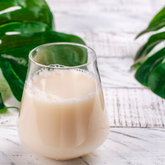
Plant-based milk isn't a trend anymore - it's a category. Oat, almond, soy, and cashew milks now sit on grocery shelves next to dairy as a permanent fixture, not a niche alternative. But behind the marketing, there's real science explaining why plant milk has grown so fast, and why how you make it matters just as much as what it's made from.
Here's what the research actually says - and why a countertop plant-based milk maker like Milky Plant Plus puts that science to work in your own kitchen.
Why Plant-Based Milk Took Over
The shift toward plant milk is driven by three overlapping factors: environmental impact, digestive health, and ingredient transparency.
Environmental footprint. One of the most widely cited studies on food sustainability, published in Science (Poore & Nemecek, 2018), found that dairy milk requires roughly 9 times more land and produces about 3 times more greenhouse gas emissions per liter than the average plant-based milk. Oat milk in particular has one of the lowest water footprints of any milk alternative, using a fraction of the water required for almond or dairy milk production.
Lactose intolerance is the norm, not the exception. An estimated 65% of the global adult population has some reduced ability to digest lactose after infancy, according to research summarized by the National Institute of Diabetes and Digestive and Kidney Diseases (NIDDK). Plant-based milks sidestep this issue entirely, since they contain no lactose by definition.
Ingredient control. Store-bought plant milks often contain stabilizers like gellan gum or carrageenan, added sugars, and preservatives to extend shelf life - sometimes for months. Homemade plant milk has none of that. It's just the plant, water, and whatever you choose to add.
What's Actually in Store-Bought Plant Milk?
Read a carton label and you'll typically find:
- Water (often 90%+ of the product)
- A small percentage of the actual plant base - some commercial oat and almond milks contain as little as 2-7% oats or almonds
- Stabilizers and emulsifiers to prevent separation on the shelf
- Added vitamins and minerals (calcium carbonate, vitamin D2) to match dairy's nutritional profile, since plants don't naturally contain these in the same form
- Often, added sugar - even in "unsweetened" versions, trace sweeteners can appear depending on the brand
None of this is necessarily harmful in small amounts, but it does mean the "milk" you're drinking is often a diluted, stabilized version of the real ingredient - designed for a 30-90 day shelf life rather than for nutrition or taste.
The Nutrition Science: Homemade vs. Store-Bought
When you make plant milk fresh, the nutrient profile changes in a few measurable ways:
|
Factor |
Store-Bought |
Fresh Homemade |
|
Plant concentration |
Often 2-10% |
Customizable, typically higher |
|
Preservatives |
Common |
None |
|
Shelf life |
30-90+ days (or longer, shelf-stable) |
3-5 days (refrigerated) |
|
Added sugars |
Frequently present, even in "unsweetened" lines |
Zero, unless you add your own |
|
Fiber content |
Often filtered out |
Can retain more, depending on straining |
|
Fortification (Vitamin D, B12, Calcium) |
Often added |
Not present unless supplemented |
The trade-off is clear: store-bought wins on convenience and fortification, while homemade wins on ingredient purity, freshness, and control. This is exactly the gap Milky Plant Plus is built to close - it gives you the higher plant concentration and zero-additive profile of homemade milk, without the manual straining and prep time.
How a Plant-Based Milk Maker Changes the Process
Traditional homemade plant milk requires soaking nuts or grains, blending them with water, and straining through a nut milk bag - a process that's messy and time-consuming enough that most people give up after a few tries.
Milky Plant Plus automates the three steps that matter most for nutrition and texture:
- Controlled extraction - blending at a consistent speed and duration to pull the maximum amount of protein, fat, and micronutrients from the plant base, rather than under- or over-processing it.
- Built-in straining - separating pulp from liquid automatically, so you get a smooth, drinkable milk without manual filtering.
- Consistent water-to-base ratio - letting you control concentration directly, so your milk can be as rich or as light as you want, unlike fixed store-bought formulations.
The result is fresh plant milk with a higher concentration of the actual plant ingredient, made in minutes, with nothing added unless you choose to add it yourself (a date for sweetness, a pinch of salt, cinnamon, vanilla).
Which Base Should You Choose?
Different plant bases offer different nutritional strengths:
- Oats - highest in fiber (especially beta-glucan, linked to cholesterol management), naturally creamy texture, lowest environmental footprint
- Almonds - lower in calories, naturally contains vitamin E, but higher water footprint in production
- Soybeans - closest to dairy in protein content (roughly 7-8g per cup), a complete protein source
- Cashews - very creamy texture, good source of healthy fats, milder flavor
There's no single "best" base - it depends on whether your priority is protein, fiber, environmental impact, or taste.
The science is consistent: plant-based milk offers real environmental and digestive advantages over dairy, but not all plant milk is equal. The version in most cartons is a diluted, stabilized, shelf-stable product built for retail logistics not for nutrition. Making it fresh, at home, from real oats, almonds, soy, or cashews closes that gap.
Milky Plant Plus was built for exactly this: real plant milk, made fresh, with the concentration and purity that store shelves can't offer.